
Nothing happens in total isolation. From a quiet multibillion-dollar executive maneuver that bypasses legislative oversight to the hidden economic toll of an escalating conflict in the Middle East, this deep dive maps out the precise chain reactions that ripple directly from federal courthouses and foreign choke points into your daily life. To fully grasp how these shifting geopolitical tectonic plates are reshaping our collective future, you need to hear the complete analysis. Click the audio file to listen now.
Inside this Episode:
The Academic Self-Censorship Crisis
A recent, comprehensive survey of 280 scientists across 131 universities reveals that a staggering 93% view recent federal science policies negatively. Far from standard academic dissatisfaction, strict new immigration restrictions and structural changes to funding allocation have induced a pervasive culture of fear. Over half of the respondents report measurable declines in federal grant allocations and constant deportation anxiety among international scholars. Most alarmingly, half of these leading minds are actively self-censoring—stripping critical keywords from research proposals to avoid federal scrutiny, while a third have abandoned sensitive research projects entirely. This systemic brain drain threatens to manifest as a severe technological deficit in the coming decade.
The Compounded Border Tax Illusion
The implementation of a 25% tariff on all Canadian goods entering the United States introduces an unprecedented disruption to a highly integrated manufacturing ecosystem. Under the United States-Mexico-Canada Agreement, components for the automotive and aerospace industries routinely cross the border multiple times during production. Because the tariff applies at every single crossing, the nominal 25% tax compounds into an effective 60% to 80% financial burden for domestic supply chains. In retaliation, Canada has not only mirrored these tariffs but has also spearheaded the creation of the Defense Security and Resilience Bank in Montreal. Comprising 19 founding nations, this institution explicitly excludes the United States, signaling a permanent structural pivot toward strategic and financial autonomy away from the United States dollar.
The Sino-Russian Electronic Warfare Convergence
The bilateral partnership between the People’s Republic of China and the Russian Federation has deepened into a sophisticated military alliance. Intelligence briefings indicate that over 90% of Russia’s sanctioned military technology imports are now routed directly through Chinese networks. Furthermore, the People’s Republic of China has covertly trained Russian military personnel in advanced drone and electronic warfare at the People’s Liberation Army Infantry Academy. Concurrently, a 75% reduction in the regional posture of the United States Africa Command has created an intelligence vacuum in Africa. The Russian Africa Corps has rapidly occupied this space, extracting mineral wealth to fund operations in Ukraine, while China secures exclusive access to critical minerals essential for next-generation technology.
The $1.8 Billion Executive Loophole
A profound constitutional friction has emerged following the establishment of a $1.8 billion anti-weaponization fund, created quietly via a settlement between the Department of Justice and the Internal Revenue Service. Managed by a five-member panel appointed entirely by the executive branch, the fund explicitly bypassed congressional approval or oversight by utilizing a complex legal loophole regarding interagency settlement funds. The fund is designed to compensate individuals claiming improper targeting by federal authorities, including those criminally charged in connection with the January 6th Capitol riot. This aggressive expansion of unilateral executive authority faces immediate structural resistance, highlighted by a recent Supreme Court decision striking down the unilateral use of global tariffs under the International Emergency Economic Powers Act.
The Strait of Hormuz Energy Shock
The military conflict involving the United States, Israel, and the Islamic Republic of Iran has exacted a severe economic toll, with internal Pentagon assessments placing the fiscal burden between $40 billion and $50 billion due to infrastructure repair costs across the region. The resulting operational closure of the Strait of Hormuz—a maritime corridor handling one-fifth of the global oil supply—has forced shipping fleets to reroute entirely around Africa. This disruption has driven the domestic national gas average to $4.53 per gallon, costing American motorists an estimated $40 billion in unexpected expenses. The macroeconomic drag has forced the United Nations to lower its global gross domestic product growth forecast for 2026 to 2.5%, ensuring that structural inflation will likely delay Federal Reserve interest rate reductions until at least 2027.
The Autonomous Lethal Horizon
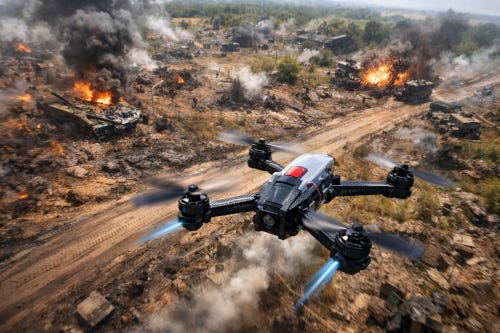
A terrifying technological leap is unfolding on the battlefields of Ukraine, where first-person view drones are now utilizing artificial intelligence paired with explosively formed projectiles. These advanced munitions utilize a shaped charge to fire a slug of molten metal at hypersonic speeds, allowing them to penetrate heavy armor from significant distances without needing close physical proximity. Because these systems employ artificial intelligence for terminal guidance during the final attack phase, they operate completely autonomously. Traditional electronic warfare tactics designed to jam the signal between a pilot and the aircraft are rendered entirely useless once the algorithm locks onto the visual signature of a target, presenting a chilling transformation in the future of kinetic warfare.
Remaining ahead of these rapidly evolving global shifts is precisely what ensures you possess the comprehensive insight required to navigate today’s complex geopolitical landscape.
When foundational international alliances and domestic innovations are simultaneously rewired from the ground up, the ultimate trajectory of the global order hangs in the balance.
How these overlapping vulnerabilities mature will dictate the reality of global governance by the end of the decade. Do not rely on fragmented headlines to understand this transformation.
Click the audio file to listen now.
#Geopolitics #GlobalTrade #NationalSecurity #ConstitutionalLaw #Macroeconomics #ArtificialIntelligence


